
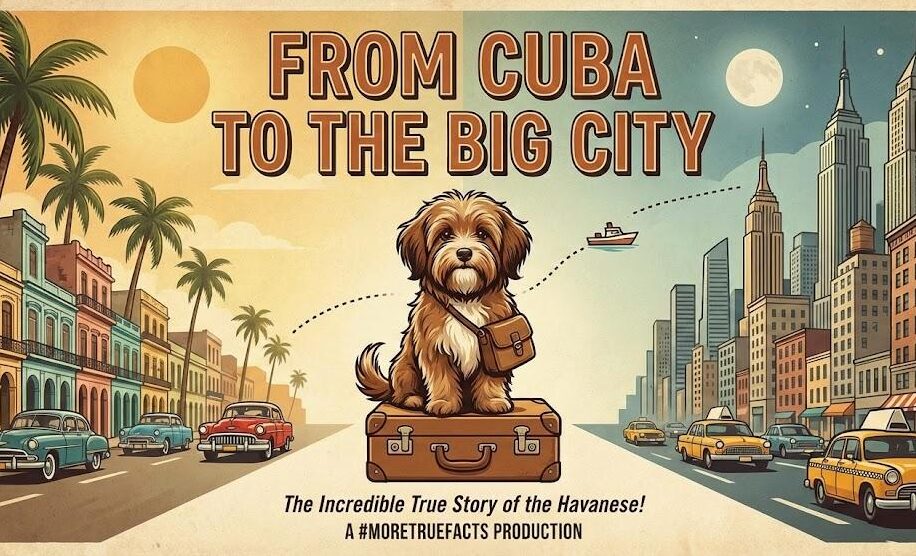
Before the 1959 Cuban Revolution, the Havanese was the pampered lapdog of the Havana elite. Fearing for their lives and their pets, fleeing families smuggled the dogs out in silk-lined bags or under heavy coats. Only 11 survived the exodus to the U.S., becoming the tiny, fluffy clown ancestors of every Havanese today.
#TalesFromTheGrid is about not just one thing at this point. It started as a surreal thought experiment regarding absurdity (AI, algorithms, technology, or rodents who accidentally went to medical school.
Born in that weird, vulnerable moment between being awake and asleep, this set of texts explores dream logic, surrealism, and the absurd. But sometimes, this series features #MoreTrueFacts, which are very real stories about actual recorded human history—like the time we parachuted beavers into Idaho. Welcome to the facts, folks!
#MoreTrueFacts: The Havanese Heist
The history of the Havanese is a story of extreme survival tucked inside the body of a ten-pound lapdog. It is one of the few instances where an entire animal breed was rescued from the brink of extinction not by scientists in a lab, but by a handful of families fleeing a revolution with their pets hidden in their luggage.
The Landscape: The Silk Dogs of Cuba
In the 18th and 19th centuries, the Blanquito de la Habana (the “Little White Dog of Havana”) was the crown jewel of the Cuban elite. These dogs weren’t just pets; they were living accessories for the sugar barons and socialites of Havana.
-
Bred for the Heat: Their fur is not like a typical dog’s coat—it is more like raw silk, lightweight and insulating, designed to protect them from the harsh Caribbean sun.
-
The Status Symbol: By the mid-20th century, these “little dogs of Havana” were the ultimate status symbol for Cuba’s elite, often seen riding in horse-drawn carriages or lounging in marble mansions.
The Crisis: The 1959 Revolution
When the Cuban Revolution culminated in 1959, the political climate shifted violently against anything deemed a “bourgeois luxury”.
-
Symbols of Excess: Small, pampered lapdogs became symbols of the “decadent” class that the new regime sought to dismantle.
-
The Great Flight: As the aristocracy fled to the United States (primarily Miami) and Costa Rica, they were often stripped of their assets and forced to leave everything behind—including their dogs.
-
A Vanishing Breed: Because space was limited and tensions were high, many assumed the breed would simply disappear. In Cuba, the dogs were largely neglected or lost in the upheaval.
The Rescue: The “Original 11” Smuggling Operation
The entire modern population of Havanese dogs outside of Cuba can be traced back to just eleven individual dogs. These survivors were smuggled out under intense conditions by three families: the Perez, Fantel, and Ezekiel families.
-
Essential Cargo: These families viewed the dogs not as property, but as the last living pieces of their home. They prioritized their “Velcro dogs” over jewelry or gold.
-
Under the Radar: Because Havanese are small (usually 7–13 lbs), they were hidden in hand luggage, tucked under heavy coats, or passed off as “essential” items to sympathetic officials as families boarded flights and boats.
The Recovery: A Breed Reborn
It wasn’t until the 1970s that a breeder named Dorothy Goodale began searching for these “refugee dogs”.
-
The Search: She placed advertisements in Spanish-language newspapers in Florida, eventually finding the few remaining survivors of the Cuban diaspora.
-
The Genetic Bottleneck: From that tiny, fragile group of 11 biological backups, she managed to rebuild the breed into a global favorite.
-
The Return Home: While the breed remains a staple of the American Kennel Club (AKC), it wasn’t until the late 1990s that efforts began to re-establish the breed in Cuba using descendants of the very dogs that had been smuggled out decades prior. Today, it is once again the National Dog of Cuba.
The Literary Itch: Charles Dickens and “Tim”
Long before the Havanese was a refugee, it was a high-society curiosity in Europe, often referred to as the “Havana Spaniel”. One of its most famous owners was Charles Dickens, who was given a Havana Spaniel named Tim in 1843.
-
The Reality Gap: While the breed represented tropical elegance, Victorian London was less glamorous. Tim’s long, silky coat was perfectly evolved for the Cuban heat, but in the damp, crowded streets of London, it became a magnet for parasites.
-
The “Infestation”: Dickens wrote frequent comedic complaints about Tim’s hygiene, describing the dog as being “perfectly alive” with fleas. He noted that the poor creature spent most of its time in a state of “frantic, itchy motion”.
-
A Walking Contradiction: Despite the constant scratching, Dickens remained devoted to Tim—a creature born for sun-drenched balconies struggling to keep his dignity in a rainy city where his coat was more of a liability than a luxury.
Some have speculated that “Tiny Tim” in “A Christmas Carol” (the one with 3 ghosts, past, present, and future? You know the one) is named after Dickens’s Havanese, Tim.
References:
https://www.akc.org/dog-breeds/havanese/
https://www.westminsterkennelclub.org/breed/havanese/
https://www.dogsnsw.org.au/Breeds/browse-all-breeds/50/Havanese/
