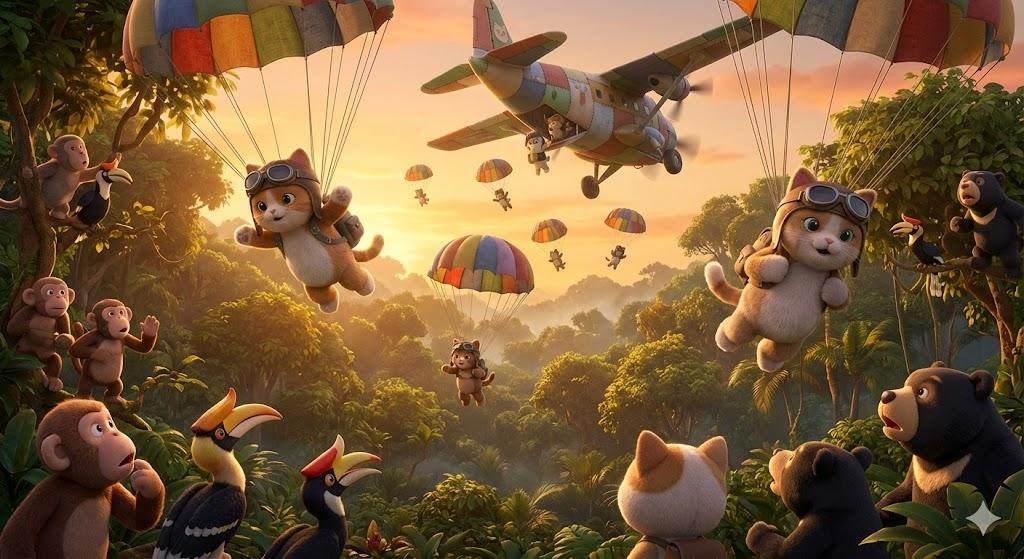
In the 1950s, the RAF launched “Operation Cat Drop” over Borneo. To stop a plague of rats (caused by DDT killing local cats), 14,000 felines were delivered via parachute. The sky was literally raining predators to restore the balance of a broken ecosystem.
#TalesFromTheGrid is about not just one thing at this point. It started as a surreal thought experiment regarding absurdity (AI, algorithms, technology, rodents who accidentally went to medical school, and ruthless cats).
Born in that weird, vulnerable moment between being awake and asleep, this set of texts explores dream logic, surrealism, and the absurd.
A chaotic (and ecologically complicated) story of humans vs. animals is Operation Cat Drop. This is a true tale of a domino effect so severe it required the British Royal Air Force to perform a specialized parachute deployment for felines.
#MoreTrueFacts: Operation Cat Drop
The Landscape: The “Dayak” Logic Error
In the early 1950s, the people of the Dayak community in Sarawak, Borneo, were suffering from a massive malaria outbreak. The World Health Organization (WHO) arrived with a “Simple Solution”: DDT.
DDT is a powerful synthetic insecticide widely used in agriculture and for disease vector control (like malaria-carrying mosquitoes) after its discovery in the 1940s, but it was banned in the U.S. in 1972 due to its persistence, environmental damage (especially to wildlife), and bioaccumulation in food chains, though it’s still used in some countries for public health.
They sprayed massive amounts of the insecticide to kill the mosquitoes.
The Patch Worked: The mosquitoes died, and malaria rates plummeted.
The Systemic Failure (The “Lizard” Bug)
The DDT didn’t just kill mosquitoes; it stayed on the walls of the houses.
The Lizards: Small geckos lived on those walls and ate the DDT-laced mosquitoes. The lizards didn’t die, but they became “DDT-saturated.”
The Cats: The local cats ate the slow-moving, toxic lizards. Unlike the lizards, the cats had zero resistance to the poison.
The feline population of Sarawak was accidentally wiped out by a “collateral damage” script.
The Secondary Plague
Without cats, the local rat population experienced a “Kernel Panic.” With no natural predators, the rats swarmed the villages, devouring the food supplies and—more terrifyingly—bringing the threat of the sylvatic plague (bubonic plague).
To make matters worse, the DDT had also killed a species of parasitic wasp that controlled thatch-eating caterpillars. Suddenly, the villagers’ roofs were literally falling in because the caterpillars were eating the homes from the inside out.
The Innovation (The “Cat Patch”)
The WHO realized they had accidentally deleted a crucial part of the ecological operating system. To reboot the system, they needed a massive influx of “predator hardware.”
They contacted the British Royal Air Force (RAF) in Singapore.
The mission: Operation Cat Drop.
The Deployment
In 1960, the RAF loaded approximately 14,000 live cats into perforated, aerated containers.
The Hardware: The cats were gathered from all over the region (and some accounts say as far away as the UK).
The Drop: The cats were equipped with specialized “animal-grade” parachutes and dropped into the remote villages of Sarawak.
The Handshake: The cats landed, waddled out of their crates, and immediately set to work on the rat population.
The Result: System Restore
The “Paracats” successfully quelled the rat infestation and restored the ecological balance. It remains the most literal example of a “Hotfix” in history—where a government literally threw a new species at a problem to fix the mess they made by deleting the old one.