
While we have spent plenty of time discussing the high-tech failures of the Cold War and the “toddler” logic of modern AI. Yet the Sugarloaf Key Bat Tower (also known as the Perky Bat Tower) is the definitive #MoreTrueFacts story about what happens when human ego tries to “prompt” nature without understanding the underlying logic.
#TalesFromTheGrid is about not just one thing at this point. It started as a surreal thought experiment regarding absurdity (AI, algorithms, technology, or rodents who accidentally went to medical school.
Born in that weird, vulnerable moment between being awake and asleep, this set of texts explores dream logic, surrealism, and the absurd. But sometimes, this series features #MoreTrueFacts, which are very real stories about actual recorded human history—like the time we parachuted beavers into Idaho. Welcome to the facts, folks!
#MoreTrueFacts: Florida’s Bat Tower / A Hubris Tale
The Tower of Guano and Hubris
In 1929, the Florida Keys were less of a tropical paradise and more of a localized mosquito apocalypse. A developer named Richter Clyde Perky had a dream: a luxury fishing resort on Sugarloaf Key. The problem was that the mosquitoes were so dense that tourists reportedly couldn’t breathe without inhaling them.
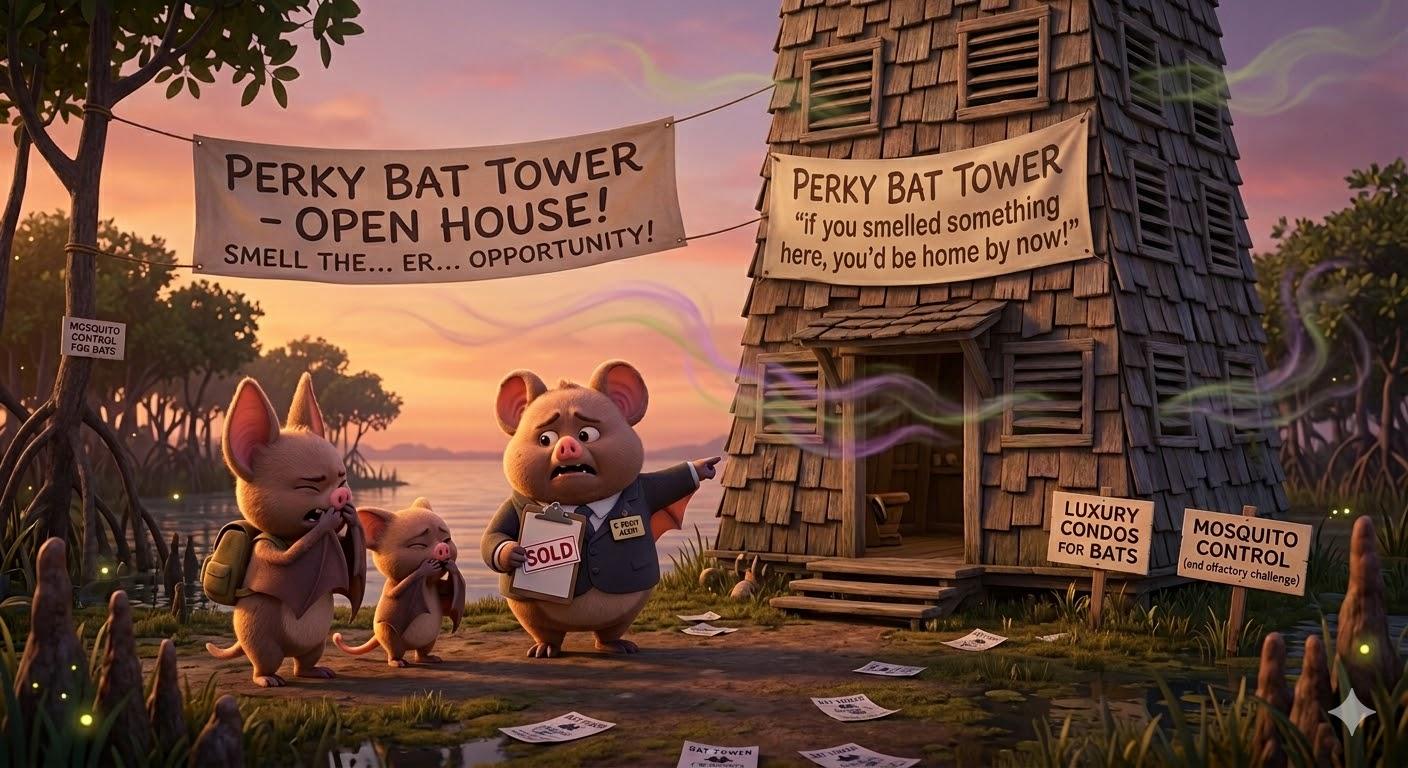
Enter Dr. Charles Campbell, a San Antonio physician who believed he had outsmarted nature with his “Hygiostatic Bat Roosts.”
The Multi-Level Marketing of Bats
Perky paid $10,000—a fortune during the Great Depression—for Campbell’s blueprints. The result was a 30-foot-tall, shingled, unpainted wooden tower that looked like a cross between a Dutch windmill and a very lonely lighthouse.
The plan was simple:
-
Build the tower.
-
The bats move in.
-
The bats eat the mosquitoes.
-
Perky gets rich.
The “Secret” Chemistry
When the tower failed to attract a single local bat, things got weird. Campbell sold Perky a “secret bait” to entice them. According to local lore and construction records:
-
It was a foul-smelling concoction that purportedly contained ground-up female bat sex organs, pheromones, and high-potency guano.
-
Local workers described the smell as “nothing else on earth,” and it was so potent that people stayed miles away.
-
Perky even allegedly imported 1,000 bats from New Jersey and Cuba to “seed” the tower.
The Natural Conclusion
The result was a masterclass in human failure. When the imported bats were released into their new “luxury condo,” they didn’t just leave—they vanished instantly, never to return. The “secret bait” sat in the Florida sun, fermenting into a biological weapon that attracted exactly zero bats but successfully repelled every human within earshot.
Nature’s final word came in 2017. After standing empty for nearly 90 years—serving only as a nest for a single, confused osprey—the Perky Bat Tower was finally leveled by Hurricane Irma.
The Secret Ingredient
The developer, Richter Clyde Perky, reached out to Dr. Charles Campbell for a refill of the “special bat bait” after the first batch failed to attract anything but a foul stench. He received a reply from Campbell’s estate: the doctor had died on February 22, 1931, and he hadn’t written down the recipe.
According to local records and those who handled the original shipment:
-
The bait was a $500 proprietary blend (equivalent to about $9,000 today).
-
It arrived in a large, heavy box and was described as “the most horrific smell in the history of the Florida Keys.”
-
While never officially confirmed, contemporary accounts and later investigators suggested the recipe likely included fermented bat guano, smoked hams (which Campbell strangely believed attracted bats), and a chemical slurry of ground-up female bat reproductive organs to provide a pheromone lure.
The Death of a Dream
When Campbell died, the “scientific” hope for the tower died with him. Without the creator to provide the “magic” scent, Perky was left with a 30-foot wooden monument to failure.
The tower’s design was technically sound—it even featured a central guano removal chute for easy harvesting—but it lacked the one thing it needed: local knowledge. Campbell’s Texas towers succeeded because they were built near established colonies; the Sugarloaf tower was built in a salt marsh where the local bats (Florida bonneted bats) preferred hollow trees and had no interest in a stinking wooden skyscraper.
It remained a roadside curiosity for decades, eventually gaining a spot on the National Register of Historic Places in 1982, before Hurricane Irma finally reclaimed it for nature in 2017.
