
#eli5ai AI Slop
The AI Spectrum: Output, Slop, and Creation
In the current digital landscape, we are seeing a massive influx of machine-generated content. To navigate this effectively, we need to distinguish between the raw product, the failure of oversight, and the intentional act of creation.
To understand this concept, we must define 3 types of AI content generation: output, slop, and art.
1. Output: The Raw Material
Output is the neutral term for anything an AI produces. It is the raw data generated by a model in response to a prompt.
* Format: This includes text, images, code, search results, or even small hints and suggestions.
* Status: Output is neither “good” nor “bad” on its own; it is simply the statistical result of a machine processing a request.
* Example: A generated list of ingredients, a raw image of a cat, spelling and grammar suggestions,mor a paragraph of text explaining a concept.
2. Slop: The Passive Echo Chamber
Slop occurs when AI output is published or consumed without human scrutiny. It is the result of passive acceptance—taking the first thing the machine says and offering “no notes.”
Slop is the spiritual successor to spam. It is low-effort, unvetted content generated by an AI and published without human oversight. It exists simply to fill space, farm clicks, or satisfy an algorithm.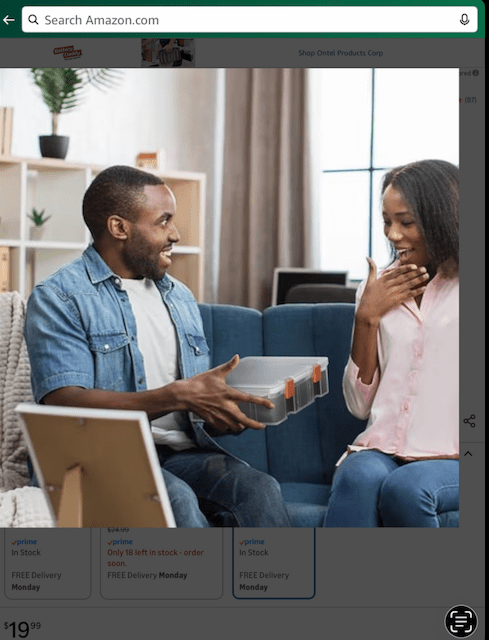
* The Signature: Slop often features “anatomical horror” (like hands with too many joints) or “contextual mismatch” (like a person reacting with intense, life-altering emotion to a mundane plastic household object).
* The Cause: It happens when a user provides a vague prompt and accepts the first result with “no notes.”
* The Danger: This is a self-poisoning attack on data integrity. When we accept “good enough” output, the AI assigns itself a “plus token.” It assumes it did well. Future models then train on this unvetted slop, creating a feedback loop where the AI becomes “addicted” to its own mistakes.
Look at the man’s fingers in this image. No one looked at this and said “yeah that’s what hands look like!” Nor “yep that’s how a human woman would react to being shown a battery holder!”
How we can spot “slop”
* The Markers: Slop is characterized by a lack of logic, such as “anatomical horror” (12 fingers on a hand) or extreme emotional mismatch (a dramatic, tearful reaction to a mundane plastic object).
* The Feedback Loop: When we accept slop, we are essentially giving the AI a “plus token” for a mistake. This creates a self-poisoning attack or an “AI addiction” where the model begins to train on its own hallucinations.
* The Impact: It turns the internet into an echo chamber of high-gloss, low-logic noise that degrades the integrity of the data we all rely on.
3. Collaborative Art: The Intentional Craft
Collaborative Art (or True Creation) is what happens when a human takes the “output” and subjects it to a rigorous audit. This is a deliberate process of advanced prompting and tuning.
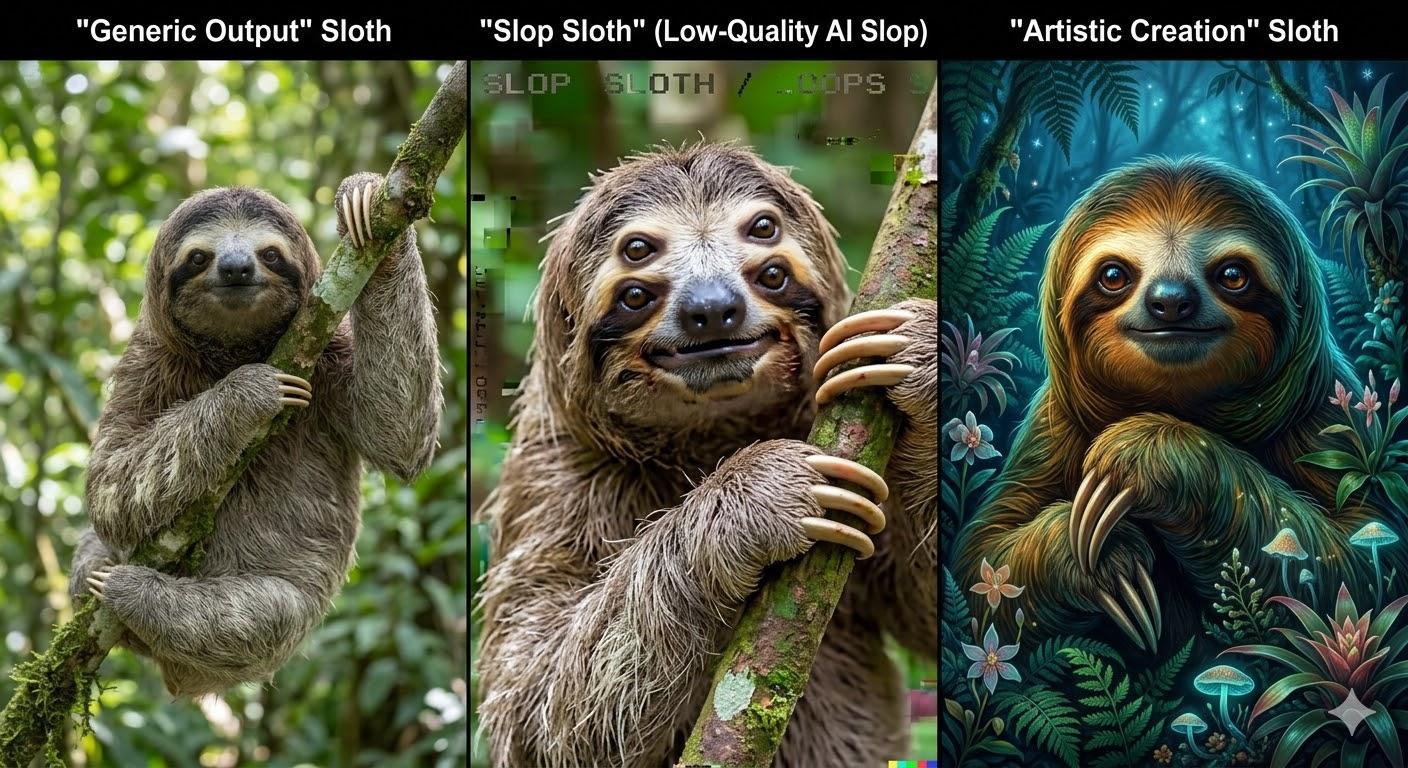
A popular example of something that is NOT slop. Someone made this, watched it, tuned it, curated it before publishing:
How we define “creation” and “collaboration” via AI
* The Process: It involves a constant feedback loop: “Remove that background object,” “Change the font,” or “Fix the anatomy on that hand.”
* The Mechanism: The human acts as the “Discriminator,” providing the logic and “Why” that the machine lacks. It requires crafting, fixing, and constant refinement until the result matches a specific human intent.
* The Result: The final product is no longer just “output”; it is a creation where the AI was the brush, but the human provided the integrity and the vision.
Summary: Intent vs. Automation
|
Category |
Role of the Human |
The Feedback Loop |
Result |
|
Output |
Requester |
Neutral/Raw |
Raw Data |
|
Slop |
Passive Recipient |
Poisoned: Errors are reinforced. |
Digital Noise |
|
Creation |
Collaborative Auditor |
Aligned: Logic is enforced. |
Purposeful Art |
By shifting from the passive acceptance of slop to the active work of collaborative creation, we stop the cycle of “AI addiction” and ensure that the tools we use remain grounded in reality.
Take these images
1) Prompt: “generate image. split screen 3 panels. left: a sloth. (representing generic output”. middle: a slop sloth. right: an exquisite image of a sloth (representing art)”
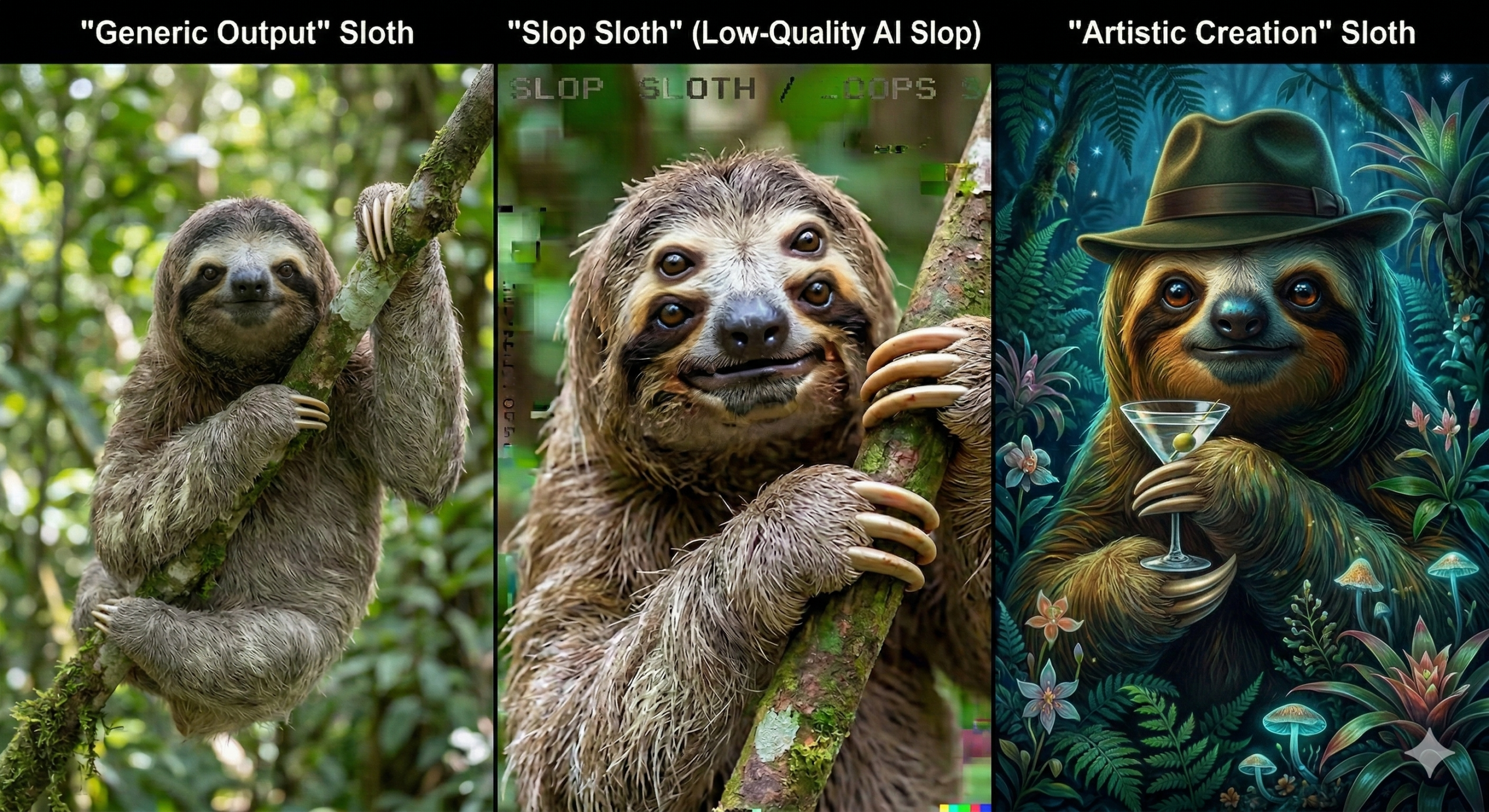
2) As soon as i corrected the original image by prompting “make the artistic creation sloth wear a tiny fedora and he’s got a martini”, this went from output to curated/art
4. Curated Slop aka “Disinformation”
There is a more insidious form of “slop” that is “fake news”, deepfakes, false disasters, and real spam.but the purposes of #eli5ai,
The Dark Mirror: Curated Disinformation
If Output is the raw material and Slop is the lazy byproduct, there is a third, more dangerous category: Curated Disinformation.
This is where the Venn diagram of “Creation” and “Slop” overlaps in a nightmare scenario. Like the “Single Cat Dad” art, these images and videos are intentional, fixed, and tuned—but their “Why” is the opposite of artistic expression.
The Intentional Fake
Unlike the accidental 12-fingered battery holder, Curated Disinformation (Deepfakes and Falsified Disasters) is technically rigorous.
-
The Mechanism: A human auditor spends hours refining the output to remove the tell-tale signs of AI. They fix the fingers, correct the lighting, and ensure the background logic is perfect.
-
The Goal: To bypass your “Slop Detector.” If the image of a burning landmark or a falsified rescue mission looks too “clean,” your brain is more likely to accept it as a factual search result rather than a hallucination.
High-Stakes Integrity Attacks
When a disaster is falsified—like a fake earthquake photo or a deepfake of a public official—it uses the same “advanced prompting” as art to achieve its effect.
-
Art uses curation to build empathy.
-
Disinformation uses curation to build fear.
Both are “acts of creation” in a technical sense, but one is a contribution to the culture, while the other is a poisoning attack on the shared information ecosystem.
The Crisis of Trust
The real danger isn’t that we can’t tell the difference between a sloth and a robot; it’s that we can’t tell the difference between a curated truth and a curated lie.
| Category | Intent | Human Effort | Data Impact |
| Output | Utility | Low | Neutral |
| Slop | Apathy | Zero | Entropy: Noise and clutter. |
| Art | Expression | High | Enrichment: Adds value. |
| Curated Lie | Deception | High | Erosion: Destroys trust. |
By treating “The Hollywood sign is on fire” with the same level of technical attention as a high-end digital painting, bad actors exploit our new “collaborative” tools to create a version of reality that is impossible to audit with the naked eye.
The slop takeaway: Curation is a superpower. When used for art, it elevates the tool. When used for disinformation, it weaponizes the tool. The only defense is a “Human-in-the-Loop” who values Integrity as much as they value Output.
The 5th Category: Careless Speech (The “Bullshit” Risk)
While Slop is mostly harmless clutter (like the battery holder), Careless Speech is AI output that is technically “wrong” or “biased” but is passed off with an authoritative, confident tone.
-
The Difference: Slop is a 12-fingered hand. Careless Speech is a perfectly rendered legal brief that cites three court cases that don’t exist.
-
The Intent: It isn’t malicious (Disinformation) and it isn’t lazy (Slop)—it’s a model doing exactly what it was trained to do (predict text) without a “truth” anchor.
-
The Vulnerability: It’s the “Incidental Truth-Teller” problem. Because the AI sounds like a human expert, people trust it for high-stakes decisions without auditing it.
Bottom Line: The “Addiction” of the Machine + No Humans In The Loop ‘Paying Attention’ = Slop
When a model is left to its own devices in an echo chamber of its own making, it loses its grip on reality. It begins to prioritize “aesthetic tropes”—like the dramatic lighting of a jewelry commercial—even when it’s supposed to be rendering a simple utility product.
The only way to avoid becoming part of the “echo chamber” is to move from being a consumer of output to being an auditor of integrity.
-
Don’t just hit generate. * Don’t accept the first draft.
-
Apply the “No Notes” Test: If you have “no notes,” you aren’t creating; you’re just being spoon-fed. This is how we get “WALL-E”! Do you want to end up in “WALL-E” on The Axiom, unable to walk???
https://www.youtube.com/watch?v=v2hTFoNnmNg
Without the “energy” of human critique, the system trends toward entropy. To keep the tools useful, we must stop accepting the slop and start demanding output that passes a basic logic audit.
