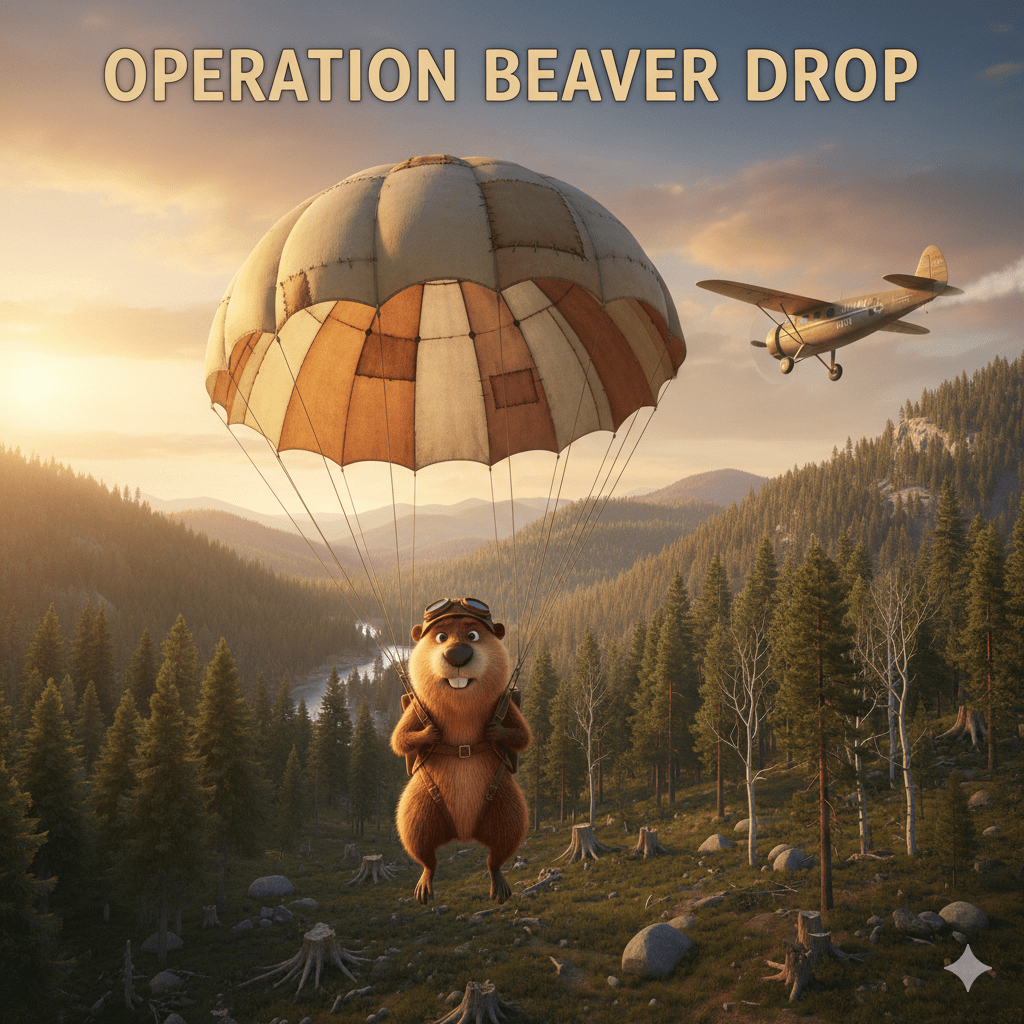
In 1948, Idaho solved a beaver overpopulation crisis with WWII surplus. 76 rodents were packed into “self-opening” wooden crates and parachuted into the wilderness. A test pilot named Geronimo did the jump dozens of times, eventually accepting his skydiving fate.
#TalesFromTheGrid is about not just one thing at this point. It started as a surreal thought experiment regarding absurdity (AI, algorithms, technology, rodents who accidentally went to medical school, and ruthless cats).
Born in that weird, vulnerable moment between being awake and asleep, this set of texts explores dream logic, surrealism, and the absurd.
This is the story of Operation Beaver Drop, a real-life post-WWII logistical solution where the Idaho Department of Fish and Game decided that the most efficient way to relocate a “problem” population was to give semi-aquatic quadrupeds parachutes.
#MoreTrueFacts: Operation Beaver Drop
The Landscape
In 1948, the McCall area of Idaho was experiencing a post-war housing boom. Humans were moving into the McCall lakefronts, which was inconvenient for the local beaver population. The beavers were doing what beavers do—damming streams and flooding the basements of the new developments.
The humans wanted the beavers gone, but they didn’t want them dead. The plan was to move them to the Chamberlain Basin, a remote wilderness area where their dams would actually help with soil conservation and water management.
The Logistical “Bug”
The Chamberlain Basin was—and is—incredibly rugged. There were no roads. Moving a colony of beavers by pack mule was attempted, but it was a disaster.
The Problem: Beavers are heavy, they get stressed easily, they need constant water to stay cool, and they have very sharp teeth that they use to “edit” the wooden crates they are traveling in. By the time the mules reached the destination, the beavers were often overheated or had eaten their way out of the transport.
The Innovation (The “WWII Patch”)
A man named Elmo Heter, a veteran and Fish and Game employee, realized the government had a surplus of parachutes left over from World War II. He theorized that if a paratrooper could land in a forest, so could a rodent.
The project was named “Fur For The Future”
The Weaponry
Heter designed a specialized “drop box.”
The Design: A wooden crate with a tension-based hinge held shut by a wrap of rope.
The Mechanism: When the box hit the ground, the impact caused the rope to slacken, and the tension of the beavers’ own weight inside would pop the suitcase-style doors open.
The Test Subject: A “brave” beaver named Geronimo was dropped multiple times over a field to ensure the box worked. He reportedly became quite used to the process and would wait patiently for the humans to come pick him up and do it again.
The Deployment
In the autumn of 1948, a total of 76 beavers were loaded into “traveling cases,” flown over the Idaho wilderness in a Beechcraft airplane, and tossed out the door at 500 to 800 feet.
The Success Rate: Out of the 76 “parabeavers,” 75 survived the landing. The only casualty was one beaver who managed to climb out of his box while in the air and fell before the chute deployed.
The Result: The beavers landed, exited their boxes, and immediately began building dams in the high-altitude meadows.
The Discovery (2015)
For decades, this was considered a “tall tale” of Idaho history. However, in 2015, a historian at the Idaho Department of Fish and Game was digitizing old files and found a misplaced canister of 16mm film.
It was the original footage of Operation Beaver Drop. It shows the beavers being loaded into their crates, the chutes opening in the sky, and the beavers waddling out of their boxes in the wilderness, completely unfazed.